


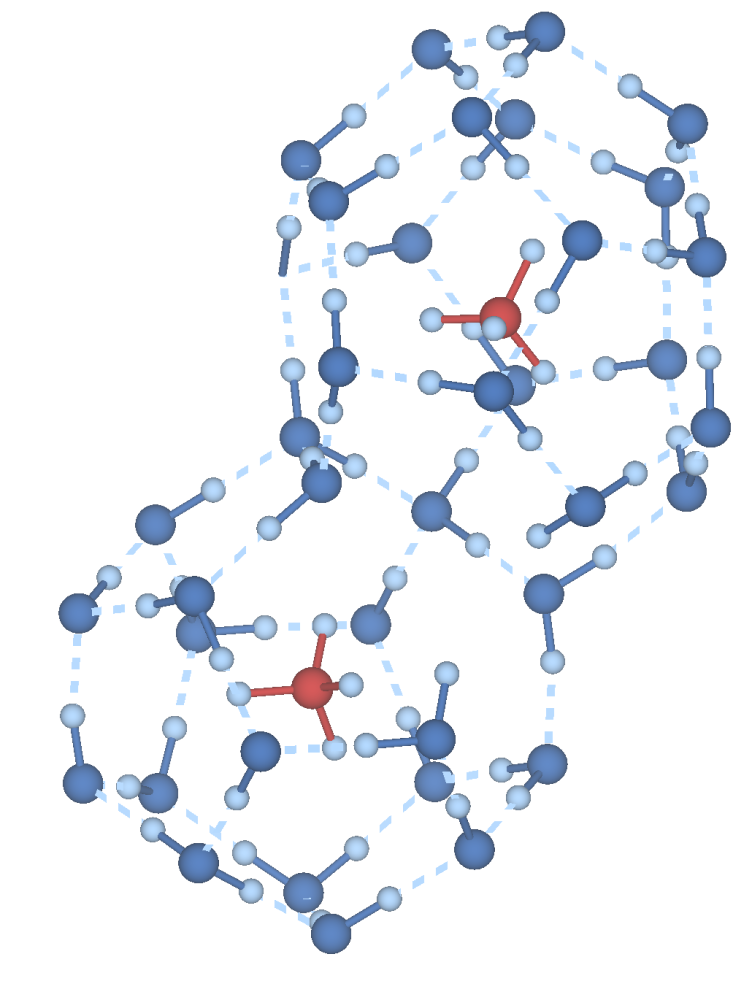
Assistant Professor Prashun Gorai has received a two-year ACS Petroleum Research Fund (PRF) Doctoral New Investigator (DNI) grant from the American Chemical Society to investigate how crystallographic defects influence the stability and behavior of methane hydrates, which are ice-like phases with major implications for global energy resources and environmental risk.
Methane hydrates (MHs), formed when water and methane combine under high-pressure, low-temperature conditions, occur in deep-sea and polar sediments on Earth and may also exist elsewhere in the solar system. Although MHs represent a potential energy source, their tendency to decompose and release methane complicates extraction and raises environmental concerns. They also form unintentionally in gas pipelines, where they can cause blockages and equipment failure.
While researchers have made progress mapping MH phase diagrams, the role of defects in governing phase stability, gas diffusion, and growth/decomposition kinetics remains largely unknown. Gorai’s project will use first-principles calculations, molecular dynamics, and machine learning to quantify defect types and concentrations and to develop the first predictive, defect-aware framework for methane hydrate stability.
“Experiments struggle to capture the behavior of these metastable materials,” Gorai said. “Computational modeling lets us explore how defects shape their stability and transport properties at the molecular level.”
The project also adapts advanced defect-modeling approaches from semiconductor science to clathrate hydrates – an approach rarely attempted in this field. “This grant allows us to test new hypotheses and develop tools that can transform how we understand methane hydrates,” Gorai added.
Gorai, a faculty member in RPI’s Department of Chemical & Biological Engineering, leads the 3D Materials Lab, which focuses on computational discovery and design of functional materials for energy, microelectronics, and sustainability.