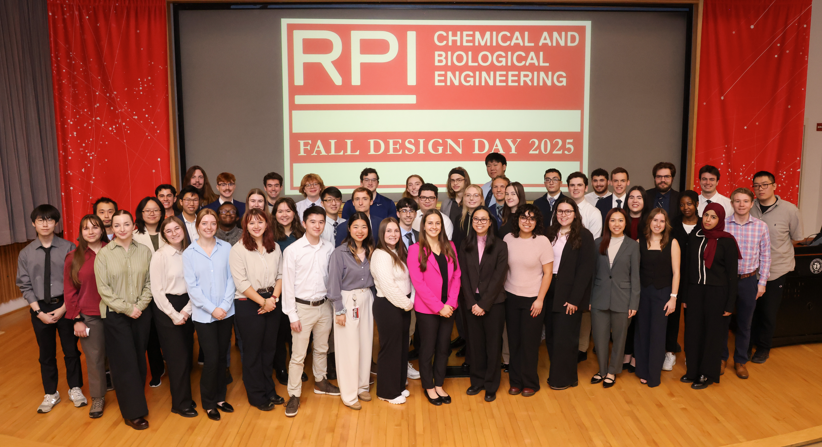
CBE continues to innovate the process design curriculum. At most universities, process design students are given a specific process with well-defined feedstock and product specifications. About 20 years ago, the faculty decided to take a different approach where each 4-person team proposes a process, slate of products, identifies the market, and chooses a plant location based on their strategy for engineering practice. Project phases include (i) technical scoping and assessment, (ii) preliminary design, (iii) preliminary economics, and (iv) final feasibility. Of course, safety is the highest priority.
Our new curriculum, initiated two years ago, includes a two-course design sequence, with Chemical Process Design: Fundamentals(Fall, with content above) followed by Chemical Process Design: Applications (Spring, with detailed unit designs, dynamic simulations, and life cycle and techno-economic analyses). For many years, Professors Nihat Baysal and Wayne Bequette have had the great fortune of adjunct faculty members, George Dalakos (GE Aerospace) and Matt Titus (Momentive), who both obtained all of their degrees from RPI and co-teach the design courses. George and Matt provide important "real-world" advice and have added tremendously to the techno-economic assessment, life-cycle analysis, and safety materials. On a Design Day, groups give brief oral presentations followed by poster presentations.
 CBE hosts a successful outside speaker whose career and practice strongly align with the Design Day spirit. This fall, the speaker was Brenda Remy, class of 2000. Brenda began her career at Merck, followed by Bristol Myers Squibb, and in the meantime earned a PhD at Rutgers. She is now Vice President and Head of Enterprise AI at GE HealthCare and presented an inspiring talk on “From Unit Operations Lab to AI Applications in HealthCare.” She demonstrated how a chemical engineering skill set can be leveraged to drive impact in the Healthcare Enterprise AI world, an eye-opening perspective for our students as they prepare for diverse career paths.
Each year, a design group is selected for the Coonley Prize. The winner this year was the Aspen Assassins, “Anhydrous Methanol Production from Natural Gas”: Rachel Borra, Anthony Ferrara, Bowen Hu, and Charles Spath. Congratulations!