The Howard P. Isermann Department of Chemical and Biological Engineering prepares students to enter their engineering practice dealing with chemical as well as physical processes to meet the challenges of the future. The curriculum, which builds on chemistry, biology, mathematics, basic sciences, and engineering science, culminates in professional applications in which theory is tempered by engineering art and economic principles. Through this curriculum, Chemical Engineering graduates are uniquely prepared to address some of societies most pressing problems including: climate change, energy security, sustainable resources, and healthcare.
Opportunities for creative and satisfying practice in chemical and biological engineering can be found in conception, design, control, or management of processes involving chemical and/or biochemical transformations. These processes range from the more conventional conversion of crude oil into petrochemicals and plastics, to the microbiological transformation of hardwood chips into specialty alcohols, or to the creation of semiconductor devices from silicon wafers. Diverse career choices exist not only in the chemical industry, but in virtually all processing industries, including agricultural, biotechnology, chemical, food, nuclear, semiconductor processing, and environmental operations. By emphasizing basic principles, the program prepares its graduates for positions spanning the spectrum of activities from research and development, to process and project engineering, to production, or to technical marketing.
The chemical engineering program comprises a minimum of 39 courses, which include three free electives and three area electives: one in advanced chemistry, one in advanced chemical engineering, and one in a nonchemical engineering area. On completion of three years of the baccalaureate program, the student may continue to the fourth year or be admitted to the professional program. While individual variations may be made in the course sequence in consultation with a faculty adviser, all listed courses and elective credits in the curricula must be satisfactorily completed to qualify for the specified degrees. The complete curriculum totals 131 credit hours.
For details regarding course requirements please consult the course catalog.
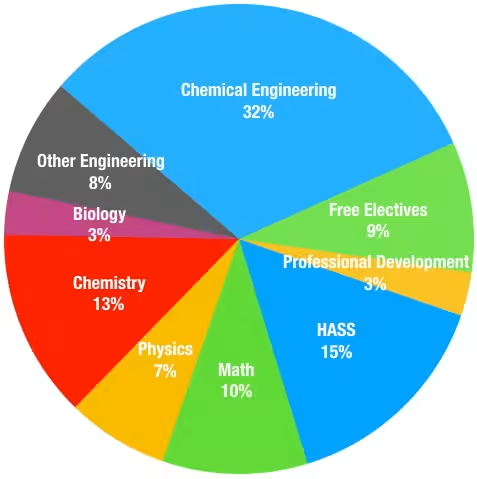
Classes Towards Chemical Engineering Degree
- Chemical Engineering: 32%
- HASS: 15%
- Chemistry: 13%
- Math: 10%
- Free Electives: 9%
- Other Engineering: 8%
- Physics: 7%
- Biology: 3%
- Professional Development: 3%