Living organisms, from the cellular to the body-system level, present elegant designs that realize desirable structures, properties and functions. Tendons and muscles, for example, are tough yet soft thanks to hierarchical structures rarely found in synthetic materials. Our neuromuscular system senses and responds to motion with built-in feedback control, an intelligence manmade systems lack. Gels, liquid-laden crosslinked polymer networks, have tissue-like water-rich porous structures and change their volume and properties in response to environmental cues. At the UCLA He lab, we study processing-structure-property-function relationships of hydrogels and their derivatives to create (i) 'bio-like' structures and properties and (ii) 'life-like' intelligence in soft materials for robotics, biomedicine, energy and environment. This talk will show how mastering polymer-water interactions through physical processing makes this possible. Using classic chemical physical principles to modulate macromolecule assembly into complex networks, we can break fundamental limits in mechanical, diffusion and electrical properties. Three handles will be discussed: thermodynamically, ions and cosolvents drive chain aggregation; kinetically, chain mobility and processing sequence set when the structure locks in; spatially, directional freezing and temperature gradients direct where it forms, programming hierarchy across length scales. With feedback and time delay built into the material itself, responsive gels and elastomers track, oscillate and roll autonomously. The resulting soft materials, combining high toughness, ion/electron conduction, fast response and 'synthetic intelligence,' enable energy-self-sufficient robots, personalized medical implants, smart wearable electronics and battery-powered flight.
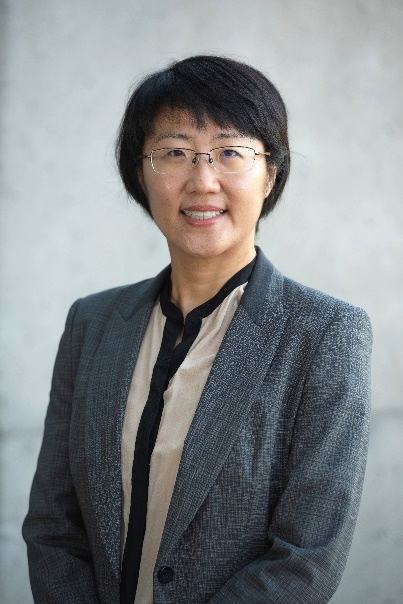
Ximin He is a professor of Materials Science and Engineering at University of California, Los Angeles (UCLA). Dr. He was postdoctoral research fellow in the Wyss Institute of Bioinspired Engineering at Harvard University. Dr. He received her PhD in Chemistry at Melville Laboratory for Polymer Synthesis from University of Cambridge. Dr. He’s research focuses on bioinspired soft materials, structural polymers and their physical, mechanical, electrical and photothermal properties with broad applications in biomedicine, energy, environment and robotics. Dr. He is the recipient of the NSF CAREER award, AFOSR Young Investigator award, CIFAR Global Scholar, SES Young Investigator Medal, Moore Inventor Fellow, Johnson & Johnson WiSTEM2D award, International Society of Bionic Engineering (ISBE) Outstanding Youth Award, Advanced Materials Rising Star Award, 3M Non-tenured Faculty Award, Hellman Fellows Award, and UCLA Faculty Career Development Award. Her research on bioinspired tough hydrogels, phototropic, phototaxic, homeostatic and anti-icing materials have garnered a number of regional and international awards and was featured in >100 international news outlets.